




Media Center > Story
World Learning trains teachers using U.S. practices to build English proficiency and economic opportunity
March 9, 2026
By Abby Henson
The United States has always played a leading role in promoting English education worldwide through professional training programs, academic exchanges, and international partnerships that connect students with American methodologies and practices. This is driven by the fact that English is the de facto language of global business, academia, and travel.
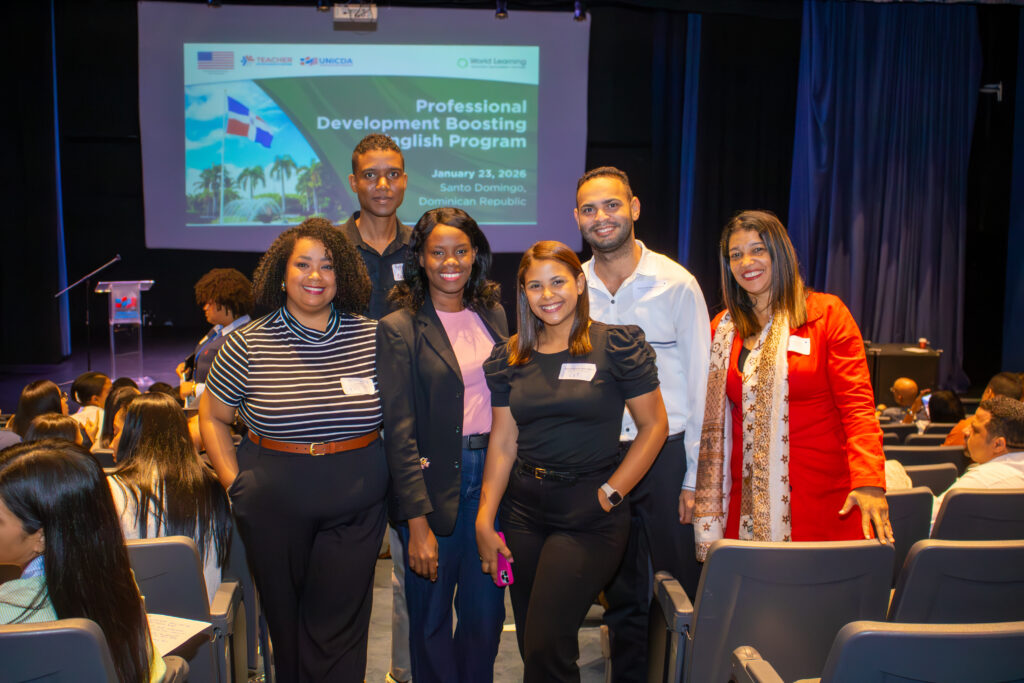
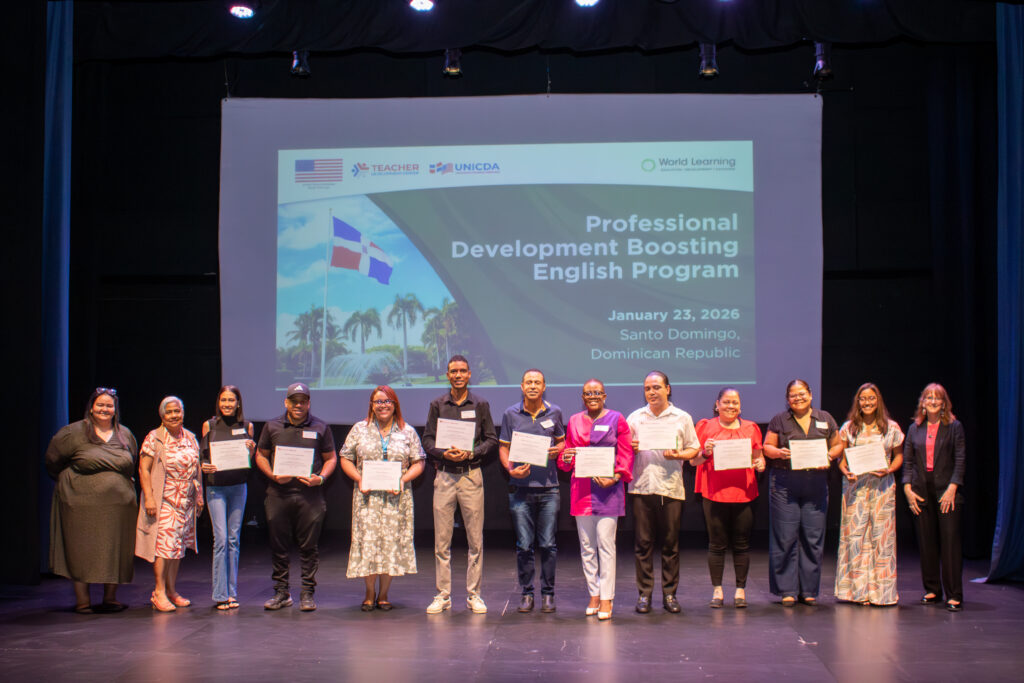
World Learning knows English is increasingly vital to success in the 21st-century workplace and higher education. From December through January, it trained several hundred English language teachers in the Dominican Republic, opening doors to greater opportunities for the participants and the United States.
The main goal of the professional development program was to equip teachers with practical, communicative teaching strategies that would help their students with real-world English skills for employment and education. Furthermore, both the Dominican teachers’ cohort and their students expanded their professional networks and are better prepared to collaborate with U.S. institutions and businesses.
“At a broader level, the program contributes to economic development. Stronger English skills can support opportunities in sectors that rely on English, including tourism, business services, technology, and trade. English proficiency can also help individuals and organizations connect more effectively with global markets and international partners, including U.S. companies.”
“The program was designed to strengthen the teachers’ ability to teach essential English language skills in communicative ways and provide practical strategies they can use immediately in their classrooms,” said Lois Scott-Conley, a senior advisor of curriculum and training for World Learning. “This, in turn, supports the long-term development of English proficiency among Dominican students, which they can use in professional and educational settings.”
World Learning implemented the program, sponsored by the U.S. Embassy in the Dominican Republic, in partnership with the Teacher Development Center of the Universidad Domínico Americano.
The curriculum was comprised of a carefully curated selection of online courses that combined asynchronous and synchronous sessions. Course topics focused on how to teach more communicatively, develop reflective practices in the classroom, and design project-based learning. The teachers were taught strategies to adapt lessons to different proficiency levels and to create tasks that reflect specific communication used across a range of educational and professional contexts.
An initial virtual orientation session by Scott-Conley in December taught participants how to use the program’s Learning Management System to effectively access and engage with course materials. At the program’s conclusion in January, Scott-Conley also led an in-person workshop, teaching the cohort key strategies for professional goal setting and growth.
“At a broader level, the program contributes to economic development,” said Scott-Conley. “Stronger English skills can support opportunities in sectors that rely on English, including tourism, business services, technology, and trade. English proficiency can also help individuals and organizations connect more effectively with global markets and international partners, including U.S. companies.”
In the post-program survey results, participants reported being “satisfied” or “very satisfied” with the course’s effectiveness, and nearly all rated it as “extremely useful” or “very useful.” Ninety percent of respondents reported increased confidence in using course ideas, consistently noting the content’s practical, classroom-ready nature as a positive aspect of the program. When asked, “What is one idea you can use?”, participants noted using real-life contexts to teach more meaningful communication.
“One idea I can use is the ‘information gap activity’ to promote real communication in the classroom. This activity helps students interact, ask questions, and share information meaningfully while using English for a real purpose,” said one teacher, referencing a strategy that pairs two or more learners, each knowing a varying amount of information. The students must collaboratively communicate to solve a problem. Scott-Conley says this type of instruction has direct implications for strengthening communication in the international workforce.
“By strengthening classroom instruction and expanding access to effective teaching practices, the program helps build a stronger foundation of English proficiency that can increase career opportunities, economic resiliency, and international engagement,” said Scott-Conley.