



Media Center > Story
From American classrooms to Egypt’s tech economy: Global UGRAD alumni put U.S. lessons to work
November 6, 2026
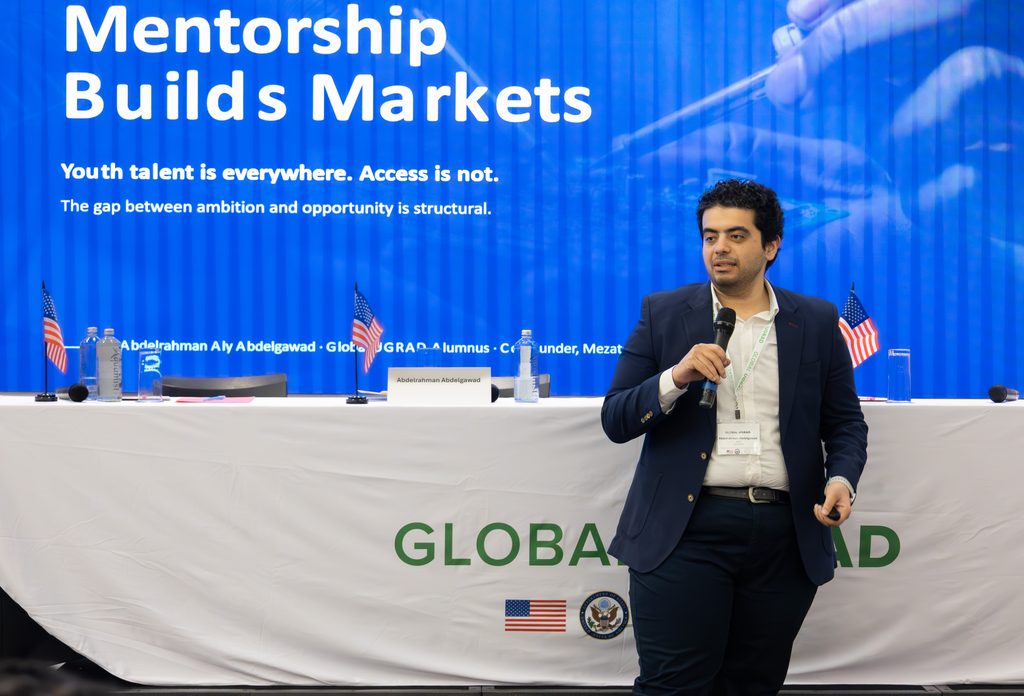
For Egyptian technology leaders Abdelrahman Aly and Mahmoud Taha, a semester in the United States through the U.S. Department of State’s Global Undergraduate Exchange Program (Global UGRAD) did more than expand their education. It shaped the companies and programs they now lead—and it is producing skilled talent, commercial partnerships, and new business for American companies.
Global UGRAD, implemented by World Learning, brings outstanding undergraduate students from around the world to U.S. colleges and universities for a semester of academic study, professional development, and community service. Aly and Taha returned home with technical knowledge, professional networks, and distinctly American approaches to problem-solving and entrepreneurship. Today they are using them to train young Egyptians, connect Egypt’s growing technology sector with U.S. investors and partners, and send student chip designs to be manufactured in the United States.
Seizing the day—and building a business
Aly is co-founder of Mezatech, a circular economy startup that extends the life of electronic devices through repair, refurbishment, and resale. Its brands include Fixtech, which repairs devices; Black Mint, which sells certified refurbished electronics; and Fixtech Enterprise, which provides repair services to companies. Mezatech is also developing an electronic-waste recycling facility.
The company traces back to Aly’s first day at Mercyhurst University in Pennsylvania, where he encountered the university’s motto, “carpe diem,” or seize the day.
“It ceased to be a quotation and became an instruction,” he says. “Carpe diem is the reason I started Mezatech. Mezatech would not exist without that year that enlightened my reflections and how I view the world.”
At Mercyhurst, professors expected students to question assumptions and defend their ideas. When classmates reached different conclusions on the same marketing case, the professor had them present and defend their competing positions to “build a process for disagreeing productively.”
“Silence was not accepted,” Aly says. “Being called on without warning was uncomfortable, and that discomfort was the point. I learned that a challenging environment produces resilience faster than a comfortable one.”
Jobs at home, a gateway for U.S. partners
“UGRAD gave me a privilege that most people I grew up with never had: a year of world-class education, mentors, and a network that later opened doors across the region,” Aly says. “The natural question when you come home is how to give that same access to people who did not get on the plane. Technology was the answer because it is the multiplier. A working device is the gateway to every other opportunity, from online courses to remote work.”
Mezatech recruits and trains technicians in device repair and refurbishment, and many go on to lead teams and train others. The company also works with non-governmental organizations and educational institutions to give young Egyptians—including those without university degrees—a fast route to employment and financial independence. That job creation fosters economic stability in a region strategically important to U.S. foreign policy.
“The [Global UGRAD] alumni seminar provided incredible value, offering practical tools I now use daily as an entrepreneur, especially in communication and in effectively tailoring complex ideas to different audiences.”
Aly is also building partnerships with investors and organizations in the United States and worldwide, with “the goal of positioning Egypt as a regional hub that connects African demand for affordable, trustworthy technology with global supply.” For U.S. investors and suppliers, that hub opens a door to fast-growing African markets.
This spring, Aly expanded his network and approach to work even further at the “Freedom 250: Global UGRAD Alumni Connections,” an alumni seminar in Kenya. “The alumni seminar provided incredible value, offering practical tools I now use daily as an entrepreneur, especially in communication and in effectively tailoring complex ideas to different audiences,” he says. A visit to iHub, Nairobi’s leading technology innovation space, “directly informed our [Mezatech’s] strategy and opened key doors for collaboration.” Aly explains that his organization aims to collaborate with iHub across four broad areas: workforce readiness, business solutions, consumer access, and engaging investors in Egypt and Kenya. “We are currently planning to commence our partnership with iHub by 2027.”
An American classroom sparks a career in chips
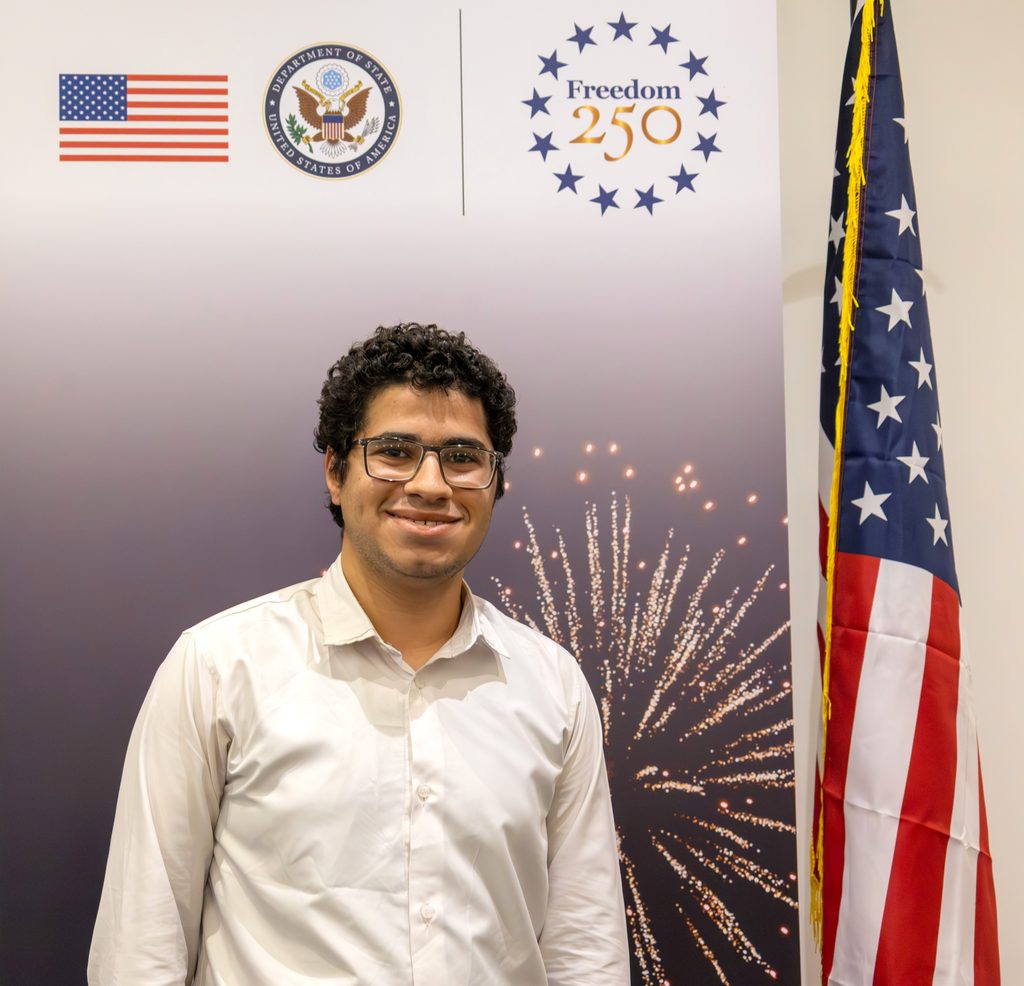
At Southern Illinois University Edwardsville (SIUE), a digital systems design course introduced Taha to chip design as a career—something he had not encountered in the same way during his engineering studies in Egypt.
“My experience studying at SIUE is what helped me find my passion in chip design and decide to pursue a professional career in Application-Specific Integrated Circuits (ASIC) chip design,” he says. Today, Taha is a teaching assistant at the School of Engineering and Computer Science at the University of Hertfordshire in Egypt, supporting courses in digital electronics, digital design, and embedded systems.
His vision is to innovate the next generation of computer architecture that enables super intelligence, and he plans to pursue a doctorate in hardware architecture or security.
“What I learned in my political economy class about the American people’s fight for freedom and rights, and about the American mentality of getting things done no matter what, made me realize that, in the end, it’s my responsibility to achieve my goals.”
At SIUE, Taha was struck by his access to professors and well-equipped laboratories. He also took courses outside engineering, including political economy, entrepreneurship, and small business management.
“What I learned in my political economy class about the American people’s fight for freedom and rights, and about the American mentality of getting things done no matter what, made me realize that, in the end, it’s my responsibility to achieve my goals,” Taha says.
Drawing on management skills from his SIUE business courses, he founded EdPurposes, which helps high school students plan for college and apply to international programs like Global UGRAD, and BeniChips, which expands access to semiconductor design for undergraduates. Both were inspired partly by the contrast he saw between educational environments in Egypt and the United States.
Training chip designers—and sending work to U.S. foundries
In its first year, BeniChips reached more than 110 students through webinars and more than 40 through on-site workshops in embedded systems, digital design, and analog design. It also hosted the first hackathon of its kind in Beni Suef, a town with limited resources two hours from Cairo. Most significantly, it helped organize open-silicon boot camps where students learned the ASIC design flow and manufactured their own chips.
Those chips connect Egyptian students directly to American industry.
“I believe if this initiative continues and expands to more communities, it’s going to lead to long-term prosperity for the community and the whole country. It will also develop international partnerships between Egypt and the United States as our students’ designs are manufactured in foundries in the United States like SkyWater Technology,” Taha says. SkyWater is a U.S.-based semiconductor manufacturer accredited as a Trusted supplier by the Defense Microelectronics Activity, part of the U.S. Department of War.
Taha sees a growing pipeline of skilled designers as an asset for the American semiconductor ecosystem. “Business partnerships in developing deep tech are going to rise given Egypt’s low-cost research and development, which is a huge portion of the chip design cycle costs,” he says.
“I believe if this initiative continues and expands to more communities, it’s going to lead to long-term prosperity for the community and the whole country. It will also develop international partnerships between Egypt and the United States as our students’ designs are manufactured in foundries in the United States like SkyWater Technology.”
An investment that pays off at home
A single semester in the United States set Aly and Taha on a path that now trains Egyptian technicians and engineers in American approaches, opens doors for U.S. investors and suppliers, and sends student-designed chips to be manufactured on American soil. Through alumni like Aly and Taha, Global UGRAD builds lasting ties between the United States and emerging economies around the world: training talent in American methods, sending business to American manufacturers, and opening fast-growing markets to U.S. companies.