Building a More Secure World Through International Exchange

In an increasingly globalized world, law enforcement officials agree that cross border cooperation is vital to their success, especially those who investigate and prosecute organized, crime trafficking, and money laundering.

“Crime does not know borders,” says Iva Balgac, general police director at the Service for Strategic International Police Cooperation in Croatia.

In April, she was one of 80 law enforcement officials to participate in a three-week International Visitor Leadership Program (IVLP) exchange with the focus Towards a More Safe and Secure World: Combating Transnational and Organized Crime.

The program, funded by the U.S. Department of State and organized by World Learning, brought law enforcement professionals from across Europe and the Western Hemisphere to the U.S. to build networks and learn from their American counterparts. They traveled to more than a dozen cities across the country, including Washington, D.C., Tampa, and more, and the trip culminated at the Global Security Conference in New York City.

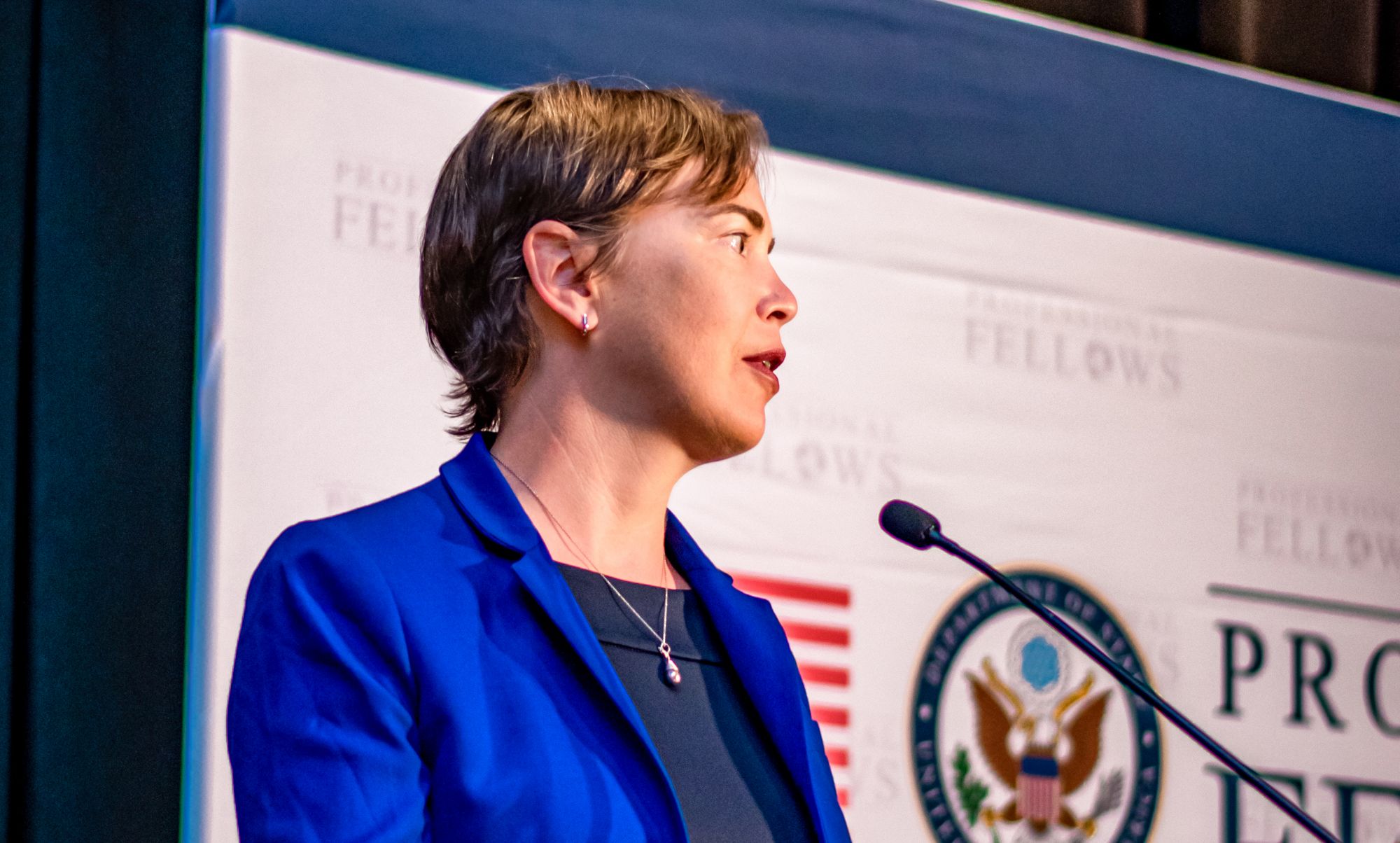
Iva Balgac, general police director at the Service for Strategic International Police Cooperation in Croatia.

“For me as a police officer, it’s always good to know a police officer in another country so that you have a direct contact and they can advise you how to solve certain issues,” Balgac says.

While police forces around the world have cooperative agreements allowing them to run a foreign license plate number or set up joint drug trafficking investigations, she says, “if you don’t have a colleague on the other side then [those agreements are] not very useful.”

Building a robust professional network is also critical for those who are responsible for crafting laws governing transnational crime. Bosnia and Herzegovina, for example, looked to U.S. practices and international standards back in the early 2000s when it was reforming its judiciary and police.

Edin Jahic analyzes policy and ensures compliance with international standards as chief of the Section for Fighting Organized Crime and Corruption at the Ministry of Security in the Balkan state. He says his country adopted tools — like plea agreements and a witness protection program — that originated in the U.S. and have proven to be very effective in Bosnia and Herzegovina as well. He hoped to get an even better understanding of U.S. policy by participating in the exchange.

“It’s not enough just to read some provision or international standard explanation,” Jahic says. “You have to understand it in practice, especially if you are not a native English speaker. One word can change the entire work.”

Program participants visited the Port Authority of New York and New Jersey to discuss the unique security requirements of the area.

In addition to meetings at federal institutions, Jahic says highlights of the program included meeting analysts from the private sector and universities. He also valued making connections with his fellow European participants.

“I am very fortunate to meet these guys,” he says. “We’ve already made some friendships that are going to last more than these three weeks and, of course, it’s going to be very helpful for my future job.”

Some of the participants already found that the exchange program is helping their work.

Juan Antonio Mateo Ciprian, a public prosecutor for the Attorney General of the Dominican Republic and director of the Department of Counterfeiting Investigations, says the exchange has given him insight into the internal and international cooperation that his U.S. counterparts employ to combat counterfeiting.

He explains that many in the Dominican government — including judges — do not consider forgery a serious crime. He wants to raise consciousness about how forgeries can be used to flout international laws and immigration policies.

IVLP participants attend a lecture at the United Nations as part of the Global Security Conference.

Laxity about forgery, Mateo Ciprian says, affects the country’s image abroad and lowers its potential for economic investment. He wants to change that by developing a training course for members of the prosecutor’s office.

“The idea is to eventually create a specialized prosecutor’s office that will help and advise all the various prosecutors in the country,” he says. “The lessons I have learned here will help me a great deal.” He also plans to use the knowledge and connections gained from the exchange program to share knowledge of forgery and contraband with the U.S. Embassy in Santo Domingo.

The Dominican prosecutor says the exchange program was not only professionally enriching but also personally interesting.

“We have seen amazing situations,” Mateo Ciprian says. “We have had visits not only to places such as prisons, but we have also met with homeless people. In general, I have been fascinated to see how crime is prosecuted in this country.”


Written by Amy McKeever, writer/editor at World Learning

Fulbright Specialist Program

What?

Link U.S. Experts and International Institutions

A program of the U.S. Department of State, Bureau of Educational and Cultural Affairs, the Fulbright Specialist Program is a unique opportunity for U.S. academics and established professionals to engage in two- to six-week consultancies at host institutions across the globe. Host institutions, including universities, non-profits, and other organizations, develop and submit projects for approval by the U.S. Embassy or Fulbright Commission in their country in wide-ranging academic and professional fields that build capacity and promote long-lasting linkages between individuals and institutions in the U.S. and abroad.

Why?

Address Priorities and Build Institutional Capacity at Institutions Around the World

An important companion to the traditional Fulbright Scholar Program, the Fulbright Specialist Program differs by providing short-term exchange experiences that tackle discrete, sometimes rapid response, projects. The Fulbright Specialist Program encourages participation of both university faculty and highly experienced non-academics, including legal experts, business professionals, public health practitioners, scientists, IT professionals, artists, and journalists. The program is a mutually beneficial opportunity for the Specialist who may not be available to leave their position for an extended period of time and the host institution which needs an experienced partner to jointly tackle a problem or examine an issue on a short-term basis.

How?

Become a Fulbright Specialist: Apply to Join the Roster

Fulbright Specialists are a diverse group of highly experienced, well-established faculty members and professionals who represent a wide variety of academic disciplines and professions.  In order to be eligible to serve as a Fulbright Specialist, candidates must have significant experience in their respective professional field and be a U.S. citizen at time of application. Eligible disciplines and professional fields supported by the Fulbright Specialist Program are listed below.

  • Agriculture
  • American Studies
  • Anthropology
  • Archeology
  • Biology Education
  • Business Administration
  • Chemistry Education
  • Communications and Journalism
  • Computer Science and Information Technology
  • Economics
  • Education
  • Engineering Education
  • Environmental Science
  • Law
  • Library Science
  • Math Education
  • Peace and Conflict Resolution Studies
  • Physics Education
  • Political Science
  • Public Administration
  • Public/Global Health
  • Social Work
  • Sociology
  • Urban Planning

Interested candidates can find more information about the Fulbright Specialist Program and apply to serve as a Specialist at fulbrightspecialist.worldlearning.org. Candidates who meet all eligibility requirements will have their full applications reviewed by a panel of their professional peers. Candidates who are approved by the peer review panels will then join the Fulbright Specialist Roster. Individuals remain on the Specialist Roster for a three-year term and are eligible to be matched with a host institution’s project abroad during that tenure.

The following costs are covered for those Fulbright Specialists who are matched to a project: international and domestic airfare, ground transportation, visa fees, lodging, meals, and incidentals. A daily honorarium is also provided.

Become a Host: Bring a Fulbright Specialist to Your Institution

The Fulbright Specialist Program allows universities, cultural centers, non-governmental organizations, and other institutions abroad to host a leading U.S. academic or professional to work on diverse, short-term collaborative projects where the Specialist conducts activities which may include, but are not limited to:

  • Delivering a seminar or workshop
  • Consulting on faculty or workforce development
  • Developing academic or training curricula and materials
  • Lecturing at the graduate or undergraduate level
  • Conducting needs assessments or evaluations for a program or institution

Institutions interested in hosting a Fulbright Specialist should contact their local Fulbright Commission or U.S. Embassy for country-specific requirements and deadlines.

Contact information for all participating countries is available on the fulbrightspecialist.worldlearning.org website.

For more information or questions about the Fulbright Specialist Program, please email [email protected].

The Fulbright Specialist Program is a program of the U.S. Department of State with funding provided by the U.S. government and administered by World Learning.

Leaders Lead On-Demand Program

Examples of past leaders Lead On-Demand Projects:

  • Vietnam Legal Aid
  • Sports Leadership Program for Colombia
  • Mongolia Disability Rights Legislation and Implementation
  • Promoting Open Educational Resources: Middle East and North Africa
  • Tourism and Development in Serbia and Kosovo
  • Religious Freedom and Interfaith Dialogue for Myanmar, India, Indonesia, Malaysia, Sri Lanka, and Thailand
  • Emerging Leaders Exchange for Northern Ireland and the Republic of Ireland
  • Getting Connected Program for the South Pacific